
A Life of Lenses

This morning on the beach, I caught myself making an assumption I make every single day without noticing.
I wasn’t wearing my contacts. So the people walking toward me were soft at the edges, the buildings a little vague, and the beach and surroundings did not have much detail. And as I walked, I assumed that this was simply what was there to be seen. That everyone passing me saw the same soft, low-resolution world I was seeing.
Then I stopped. Wait. My eyesight has diminished. Half the people moving past me are wearing contacts or have 20/20 vision. They’re seeing detail I can’t even imagine from where I stand. The lines on a face. The texture of the water. The expression of the person beside them. We are walking the same stretch of sand, looking at the same things, and seeing two completely different worlds.
What got me wasn’t the eyesight itself. It was how total the illusion is. I don’t experience my vision as limited. I experience it as the world. The diminishment is invisible to me from the inside. It just looks like reality.
And then I started noticing how this plays out in the small social calculations we make all day. If someone is twenty feet away and I can see their eyes clearly, and they seem to be looking right at me, I assume they’re looking at me. But their eyesight is not my eyesight. Maybe they can’t see me at all. Maybe they’re just pointing their face at the brightest thing in front of them, focusing on nothing, registering none of the detail I think they’re registering. I read intention into the angle of their head. I build a small story out of where I think someone’s attention is. And I’m probably wrong more often than I’ll ever know.
That’s interesting enough on its own. But it doesn’t stay on the beach.
It reminds me of the fourth grade.
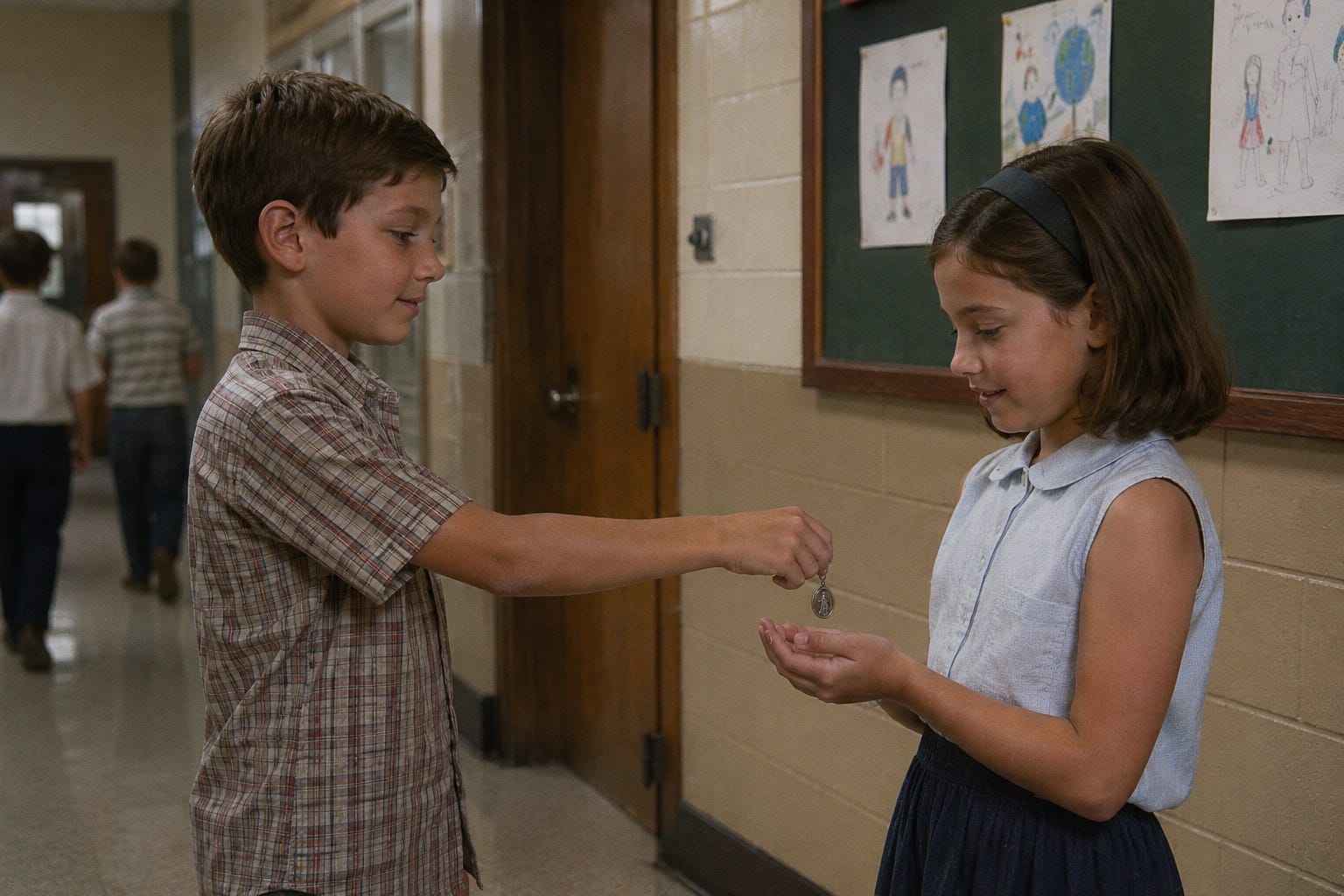
I’d had a crush on a girl named Theresa for a long time, and I finally worked up the courage — through what must have been some amount of procrastination, because it landed on a Friday — to buy a Saint Christopher medal and ask her to go steady. She said yes. I was on top of the world. I had never felt better in my life. I spent the whole weekend as a different person. A better person. At ten years old, I was a better man because of it. The weekend was a nirvana of wonderful feelings about myself, my love, and the world.
Then, on Monday, our class went on a field trip to the library, and a classmate told me Theresa was going to break up with me. Oh boy.
So I did what men of the world do. I broke up with her first. Preemptive strike. Protect yourself before the blow lands.
You already know how this ends. She had no intention of breaking up with me. The classmate was a troublemaker, handing me a story just to see what I’d do with it. And I did not disappoint. I went from the top of the world to the bottom rung of hell in the space of one walk to the library. Same girl. Same medal. Same exact facts and circumstances between Theresa and me. Nothing real had changed at all. Only something I’d heard. Only something I’d believed.
That was nearly sixty years ago, and I am still that kid on the walk to the library. The mechanism hasn’t changed. I can have the exact same circumstances — a marriage, my children, my work, my health — and on one day I perceive them as good. My feelings are light. I’m buoyant. I can stay present. Life is good. And then, without a single detail changing, except maybe something I read in the news or hear from someone or told myself in a moment of doubt, the whole thing inverts. Same glass. Same liquid. Same exact level. And I am right back to seeing the glass half empty and end up down in the dumps.
This is the oldest lesson there is. Half empty or half full. It’s almost embarrassing how simple it is. The glass doesn’t change. You change. More precisely, your perspective changes. Everyone has heard it. It fits on a bumper sticker. And I think the simplest illustrations are usually the most important lessons we get handed, precisely because they’re so easy to nod at and so nearly impossible to actually live inside.
So how do I gauge whether I’ve learned any of it? Whether all the effort I have invested in being more present and engaged has made a dent? Hard to say.
It still happens. The half-empty panic still comes. But does it happen as often? No. Progress. Am I more aware of it while it’s happening? Yes, more progress. I can also avert it most times. That’s real improvement. But it still happens.
So I decide I haven’t learned the lesson. Because if I had, it would never happen. I would remember that the things I feared in the past were almost never as bad as I feared. The suffering was never in the event. The suffering was in the months and years before it, when it was still just a story I’d chosen to believe.
But it is not true that I have made no progress. My attitude that I have not grown is no different from seeing the glass half empty. Maybe it is not meant to be something that never happens. Maybe it is the catalyst for growth we want, or the one evolution requires of us.
I don’t know how to finish closing that gap. Maybe the awareness is the closing. But I do wish that I could avoid feeling this way when it happens. I do wish I could control my thoughts and, therefore, control my feelings and attitude.
But would life become boring, would the adventure be lost?