
Did Boomers Kill Religion

I grew up immersed in God.
I was sitting cross-legged on the floor of someone’s living room. Next I was listening to a man in white robes explain that God was not a being but a vibration. Most of my life has been spent searching, seeking, being in the presence of spirit. I was absolutely certain that I had found something more authentic than anything a traditional religion could offer.
I was also absolutely certain that I would never make my future children adopt worn-out religions. No dogma. I would give them the freedom to find their own way.
I was sure this was a gift.
A Gallup poll released this week raised some questions.
Forty-two percent of young men between eighteen and twenty-nine now say religion is very important to them. That’s up fourteen points from just two years ago. They’re not saying spirituality. They’re not saying mindfulness or meditation or personal growth. They’re saying religion. And for the first time in twenty-five years, young men have surpassed young women on this measure. Church attendance among young men is up too — forty percent now report going at least monthly.
Meanwhile, the group least likely to call religion important? My generation. The boomers. The ones who were supposedly evolving into a new form of spirituality and human evolution.
We didn’t leave God. We left the building.
That’s an important distinction. We walked out of churches and synagogues and mosques because the institutions felt dead. Authoritarian. Dated. Out of step with the world we were trying to build. The structures were rigid. The theology was often fear-based. The relationship with God was conditional. Love was conditional. God was an abused and overused term.
So we went looking. Transcendental Meditation. Kabbalah. Sufism. Zen. A Course in Miracles. Sweat lodges and vision quests and weekend workshops where grown adults sobbed into each other’s arms and called it a breakthrough. We were a generation of seekers.
And God was in all of it. That’s what nobody seems to understand when they look at the data showing boomers as the least religious generation. We were drowning in God. We just refused to call it religion. Or God.
Did we make a mistake?
We were so afraid of creating dogma that we created nothing. We were so allergic to structure that we left our kids in a spiritual vacuum. We told them to find their own path, but we didn’t give them a trailhead.
Think about it. If you grow up in a household where your parents meditate sometimes, read Rumi occasionally, talk vaguely about the universe having a plan — but there’s no practice, no community, no weekly rhythm, no rite of passage, no shared language for the sacred — what do you actually have? You have parents who seem to believe in something they can’t name and won’t commit to.
We made a mistake.
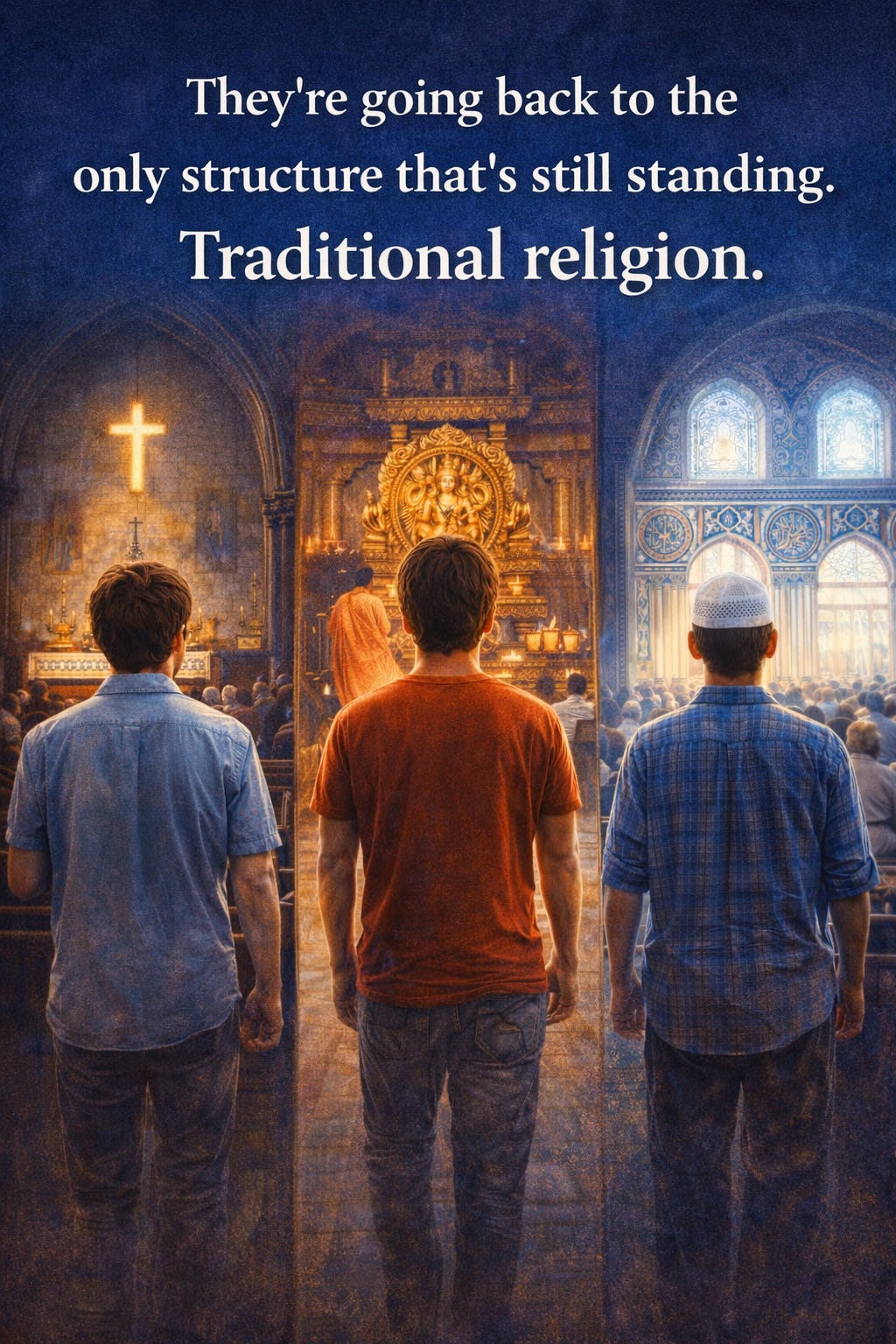
And so now our children are doing the most natural thing in the world. They’re going back to the only structure that’s still standing. Traditional religion. The churches, temples, and mosques we walked out of fifty years ago.
I find this beautiful. The disappearance of wonder and seeking has haunted me. It is the reason I write.
The human need for the sacred is not optional. It’s not a phase. It’s not something you outgrow with enough education or enough therapy. Every civilization in human history has organized itself around the transcendent, and the idea that we could raise a generation free from that need was, in retrospect, spectacularly selfish. These young people are asserting something fundamental about what it means to be human.
But another part of me grieves. Because what they’re finding in those pews includes the thing we rejected — and we rejected it for real reasons. The conditions. The theology of fear. Those problems didn’t disappear while we were off chanting in the desert. They’re still there.
But does it matter? Did we boomers overreact?
We had the ingredients. We had forty years of ingredients. We just never wrote the recipe.
Were we too lazy to build out a new path? Or were we just too selfish to build for anyone but ourselves?
We Boomers were, more than any generation before us, children of the Blank Slate. Science dogma wuz king, 'facts' were paramount, technological 'miracles' dwarfed religious miracles. So we came to worship the material, or as some call it: Mammon. The cult of individuality dictated that we seek freedom from any constraints, from customs, from our own evolutionary past. We thought we could make a better world from scratch.
In today's world, where practically any want can be satisfied, where a person can cocoon themselves in an endless succession of dopamine hits, people are tormented by a suffering that could barely be conceived of a hundred years ago. When consciousness reaches out and meets no resistance, then there is no formation, only disorientation and a deep-seated existential panic.
The Boomer's Tower of Babel was doomed from the start.