
Is God Really Number One
Family and financial security versus God

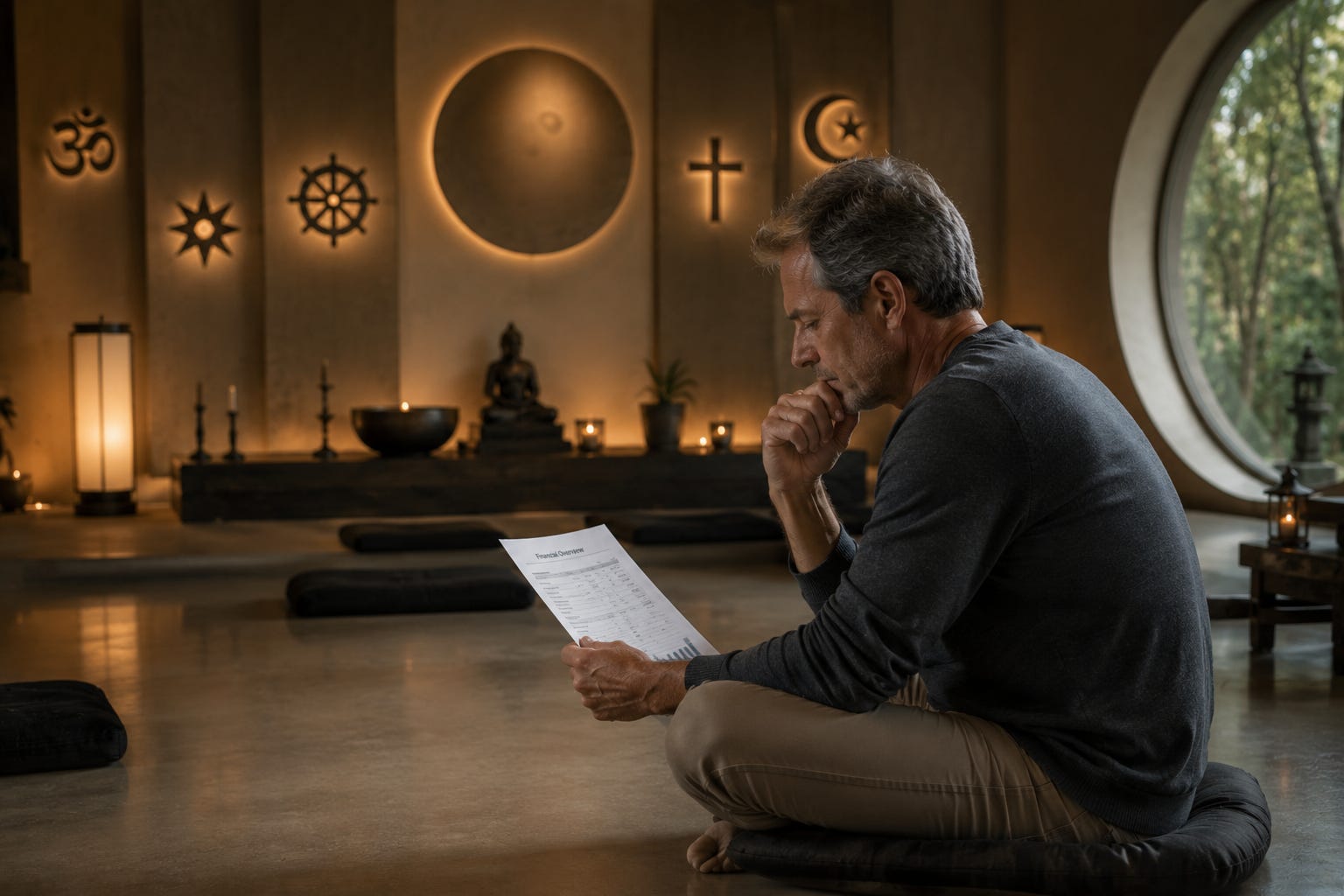
My coach asked me something simple last week when I was fretting over my current business dealings. He knows that I claim to put God and consciousness first. Mehrdad asked, “What do you actually choose?”
Not what I believe. Not what I aspire to. What do I choose?
We avoid this question, at least I have. It has suited me to have a predetermined answer, always that God comes first. But does He?
Why would I risk toppling that foundation? It is comfortable and spiritually correct. But I was vulnerable in the moment, and the answer came out the way true things do — fast and real. As though I had been waiting for a chance to stop pretending.
I choose financial security. I choose my family’s stability and happiness. I choose health. And when those things are in genuine tension with God — with what I imagine God might want, with the spiritual path I proclaim to be on — I do not choose God.
This was a shock to me. And strangely cleansing.
I’ve held God as the most important thing in my life. Since I was a young boy. It was inherent, just there. Every time I came up against a conflict, a question of whether God is real or fair or good or bad, I have always defaulted to loving God. Unconditionally. I have always imagined myself coming to a place of surrender. Giving up my will and living in God’s will.
I carried that self-image for decades, the way you carry a credential you’ve never been asked to prove. I was the person who put God first. It was central to how I understood myself — as a seeker, as a man, as someone who had touched something real in 1992 or 1993 when I had an experience of God that I still can’t fully describe. An awareness. A recognition. Something that didn’t arrive as an argument or doctrine but as a presence.
That experience changed the direction of my life. It’s the reason I’ve spent forty years reading, meditating, studying consciousness, sitting with traditions that most people encounter on a bookshelf and forget. I built a life around the question of what God is. What God wants. And I told myself, at every turn, that the answer — whatever it was — would always come first.
But what is God’s will?
Do I know? Or is it just my own version of what I think God wants? Have I adopted dogma and ideas from elsewhere? Do I actually believe God wants anything from me?
Not really.
And yet.
I proceed through life as though I do know. Righteously. With conviction that God always comes first.
But God does not come first
When I look honestly at how I actually live, the hierarchy is clear. If God asked me to choose between protecting my family and doing what I believed God wanted, I would choose my family. This honesty is important to me.
And I think I’ve known it longer than I’ve been willing to admit. Every time I chose the safe financial path over the uncertain spiritual one. Every time I prioritized stability over surrender. Sometimes I would frame things conveniently. That I was honoring God by taking care of my family, which is true. But it also meant I never had to choose. I could have both. I could keep the credential.
Mehrdad’s question took away the convenience of the lie. It asked me to stand in the gap between what I profess and how I live, and to tell the truth about what I see there.
I built my spiritual identity on the assumption that God comes first — and then arranged my life around material wellbeing, health, and the people I love. The gap between the presumed hierarchy and the lived one is a lie.
I don’t say that with self-contempt. I say it with something closer to relief. Because the lie was exhausting in ways I didn’t recognize until I stopped telling it. There is a particular kind of fatigue that comes from maintaining a spiritual position you haven’t actually earned — a low-grade tension between who you say you are and who you are at three in the morning when the numbers don’t work and your family is depending on you. In those moments, I was never praying. I was calculating.
This realization might be one of the most important of my entire life.
There’s a spiritual vanity in imagining myself as a person who would give everything up for God. A saint who abandoned possessions, family, and safety for what I understood as divine will. I’ve read about those people. I’ve studied them. I’ve admired them across centuries and traditions — the desert fathers, the mystics, the ones who walked away from everything because they heard something the rest of us only read about.
But this is not what I am. I am a man who loves God and chooses family.
And I suspect I’m not alone in this, though almost no one says it. The spiritual world is full of people who have placed God at the top of their stated priorities while living as though security, health, and family come before everything else. This isn’t hypocrisy. It’s humanity. But calling it what it is — that requires something most of us would rather not face.
This honesty does not push me further from God. It brings me closer.
Not closer the way prayer does, or meditation, or reading theology at midnight. Closer the way trust in God does. For forty years I brought God an image of myself — the devoted seeker, the man who put the sacred first. What I’m bringing now is smaller and less impressive. Just a man who loves his family, who doesn’t know, and who is done pretending otherwise.
I think that’s a better offering than the one I was making before. I think God — if God is anything like what I experienced all those years ago — would rather have the real thing than the performance.
Do you think there is something sacred about standing in front of the divine with nothing — and saying this is what I actually am?
Kudos David. Living the Truth as it is for you in the moment, and being unmasked and naked. That is your style, and what makes you extra lovable. Thank you for baring yourself and relieving yourself of the burdensome monk's cloak. Your continuing awakening is inspirational. Much love to you David.