
Passion Isn't Found. It's Noticed.

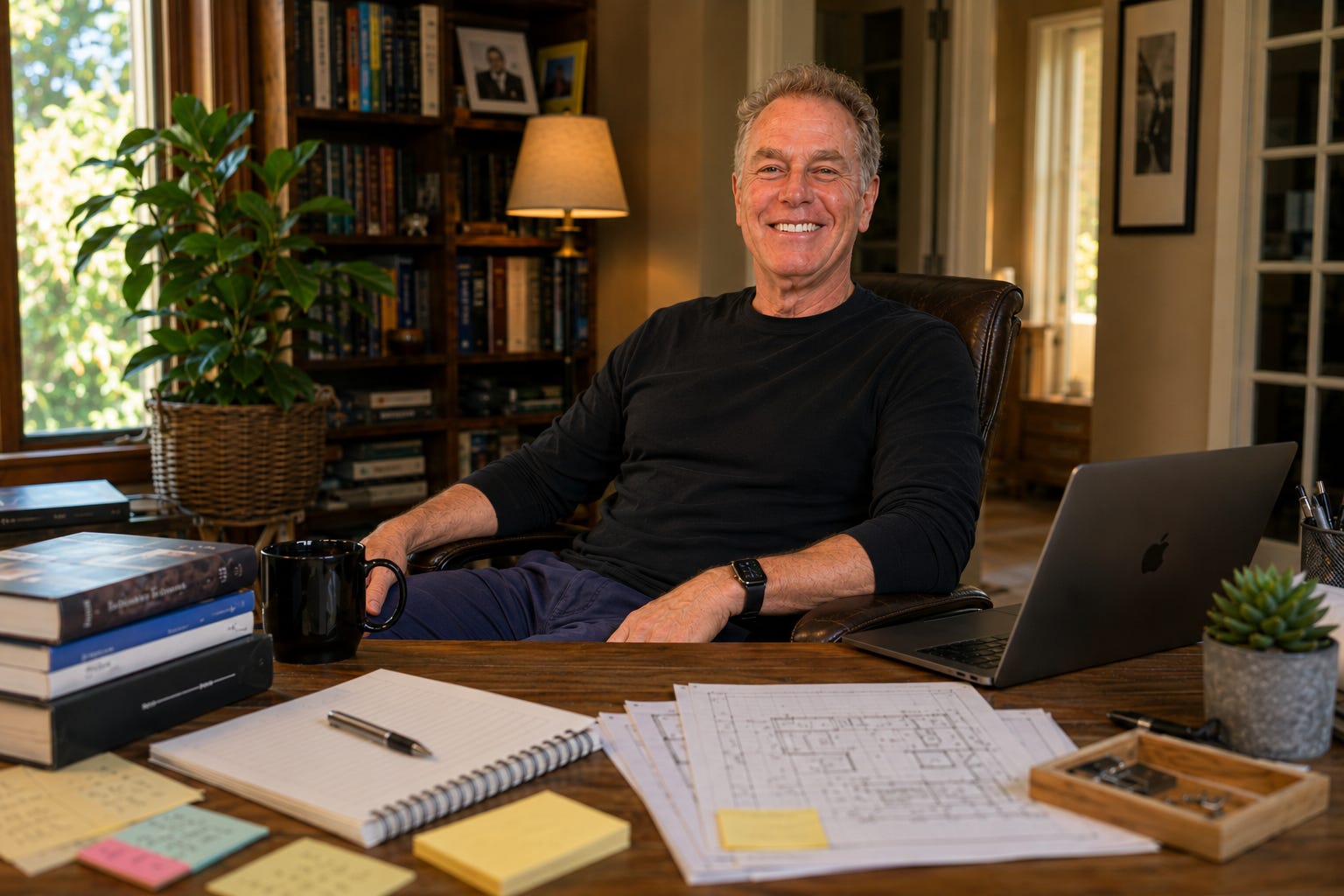
I sat down Wednesday morning to write this week’s post and started with something silly. I won’t even tell you what it was. By the time I began revisions, it became obvious that it wasn’t important. It was a silly thought I had in the shower.
So I got up and walked around the house. Made another cup of coffee. Came back. Tried again.
I pondered my desire to write about real human life. The actual reality of day-to-day life for most of us. How things that look troubling or concerning almost always turn out to be lessons. Not in a tidy way or in the way self-help books promise. It seems never to be that easy. You usually have to look back in hindsight to understand the lesson. Years later.
That felt closer. Maybe there is an observation about life there somewhere. Something I can share that provides helpful wisdom. But I needed to get clarity.
I thought about how strange it is that AI works so well for me. I mean for me specifically — the way I think, the way I write, the way I process. I have friends who’ve tried it and told me they hated it. Friends who think it’s overhyped, or shallow, or pre-programmed. Sometimes their reactions make me think we are not living in the same world.
Because for me, the development of these intelligence models is on the order of the discovery of mathematics. Or physics. I am not exaggerating to be dramatic. I think this is one of the moments in human history that will truly change the outcome of our species, and for the better.
Here is an example, and it is as much about bragging as it is a sales pitch. I am using AI to build something right now - PrepDoc AI. I also use it for my real estate development business. I thought maybe I would center the article on one of those applications, or on how I use it in writing my book, Soul Hunter: The Rise of Transhumanism, and on how controversial it is to use AI to help write creatively. Blasphemous to some. I can see their point, but that would limit my ability to share something meaningful — the questions of consciousness, substrate, and whether souls exist. These are real questions I think humanity will face.
That felt right, giving real human life the spotlight.
But then I stopped. Because I noticed something.
I had spent an hour and a half trying to figure out what to write about, but I was missing what was really going on. This was not about the AI at all.
This was about the fact that I am going to be sixty-nine in a few weeks and am the most busy, the most alive, that I have ever been.
Getting older. At some point, it becomes your topic. Same as love and relationships are topics in younger years. Then family. Or career.
The thing that kills you is not your body. Your body will go when it goes, and you don’t get much say in the timing. Or maybe you do.
I believe that what really kills you is the slow erosion of having a reason to be here. People stop being curious. They retire, and they wait. They develop hobbies that are actually just ways of running out the clock. They become interested in their grandchildren, which is fine, except that the grandchildren have their own lives, and you are no longer the protagonist of anything.
But people who have something they truly care about, that gets them out of bed because they cannot wait to see what happens next, live longer. Better. They sleep better, think faster.
PrepDoc, North Vista Highlands, and Soul Hunter all give me life. A whole lot of stress, disappointment, worry, yeah, all that too, but the passion they inject into my life makes my back hurt less. I jump out of bed like a kid in the morning. I am not making this up. There is research on this. Purpose is not a metaphor; it is a physiological state that makes life better.
I know this because I’ve lived both versions. There have been years of my life when I was successful by every measure and dying inside. And there is this year, where I am working harder than I have in a decade, and I feel really good.
Find your passion is the kind of advice that sounds true but isn't. Passion isn't a thing you find. It's what you can't stop returning to.
Look at how I started this essay. I sat down with one topic, abandoned it, picked up another, abandoned that, picked up a third, and on and on. I was not lost. I was being shown something. Every door I opened led to the same room. The AI questions. What I’m building. What I wrote. Why I write at all. The room is the same room.
If you want to know what you actually care about, don’t ask yourself what you care about. Watch where your mind goes when you’re not paying attention. Watch what you keep starting conversations about, even when nobody wants to have them. Watch what makes you defensive in a way that surprises you. Watch what you can’t shut up about.
I don’t know what your room is. I don’t know what doors keep leading you back to it. I suspect you know, even if you’ve been telling yourself you don’t, because it’s inconvenient, or it’s too late, or what would people think.
But I'll tell you what I think about "what would people think." People are thinking about themselves. They are not thinking about me nearly as much as I fear. When friends have pushed back on my AI work, I've noticed something. My reaction tells me about me. Their reaction tells me we are now both participants in movement of some kind. Thought. Pushback. Anything other than stagnation.
What is the room you keep ending up in?
And — given that you are not getting any younger, and neither am I — what would it cost you to walk into it on purpose?
David,
I love your passion. What the passion is about, as long as it isn't harmful, isn't important. Thanks for helping keep my fire going. P.S. I applaud hobbyists because they're doing what they want to do. Some people simply want to enjoy. (You seemed to diss hobbyists.)