
The Greatest Act of Bravery Has Nothing to Do With Danger

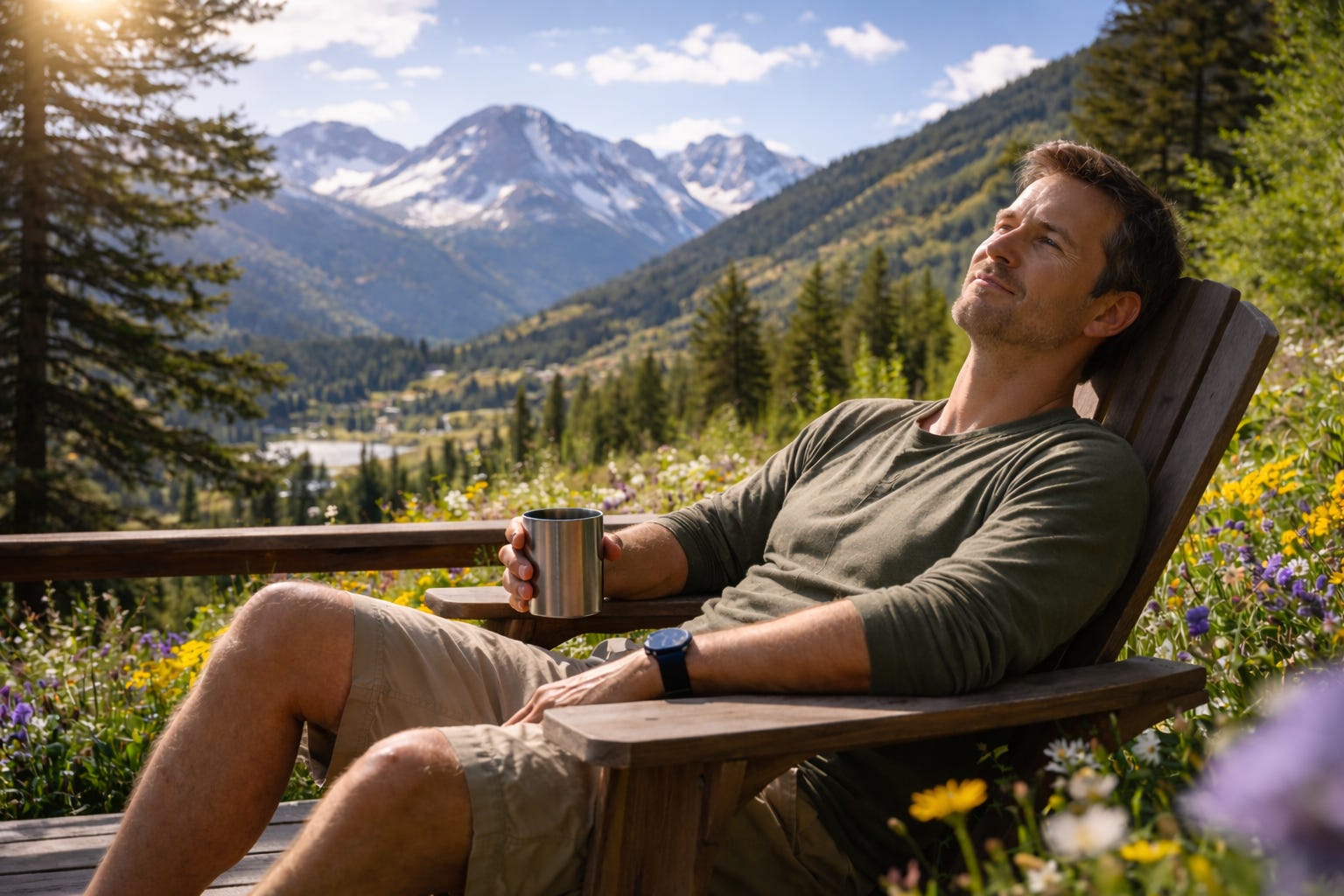
I woke up this morning to a sunny day. A beautiful day for a walk.
I almost didn’t notice.
Here is what was competing for my attention: stress. Not just personal stress but worldwide stress in the form of war and political and economic uncertainty.
My wife believes in me. She also wonders how I can possibly live with this level of stress.
I wonder too.
But here is what I noticed this morning, and what I want to talk about.
Right Now
Right now — not tomorrow, not next quarter, not in the imagined future where every bad scenario plays out simultaneously — right now, we are fine. We have a home. We have food. Everyone is healthy. My wife can go see her friends. The dog doesn’t know anything about SOFR futures. The sun is out, and it is a genuinely beautiful morning.
None of that is denial. All of it is true.
The bleak future I’ve been staring at? Also possibly true. But the key word is ‘possibly’. If I’m honest about the probabilities instead of letting my fear do the math, the odds of catastrophe are maybe fifty-fifty. Which means the odds of things working out are also fifty-fifty. I have been in tight spots before. I have seen the horizon go dark. I have always survived.
My fear doesn’t remember that. My fear only knows how to project the worst outcome and then insist I live in it now — before it’s even happened. Before it may ever happen.
Survival Mechanism
Here is what I think most people don’t understand about the human brain: it was not designed to make you happy. It was designed to keep you alive.
Those are very different assignments.
Your brain is a threat-detection machine running ancient software. It evolved to spot the predator in the grass, the rival at the edge of camp, the storm on the horizon. It defaults to danger. It is built to overweight worst-case scenarios and discount the present, because, in evolutionary terms, missing a threat is fatal, and missing a joy is inconsequential.
This is not a flaw. It kept our ancestors alive long enough to become our ancestors.
The predators have changed. The system hasn’t.
We no longer worry about famine or animal attacks, but the threats haven’t disappeared — they’ve multiplied and found new delivery systems. Financial stress is real. Health anxiety is real. War is real. And now there is an entire economy built on making sure you never forget any of it. Every notification, every headline, every pharmaceutical ad lists catastrophic effects. Every breaking-news banner about a conflict you cannot control — all of it is optimized for the exact bias your brain already has. Fear gets clicks. Danger gets attention. Your amygdala — the ancient alarm system at the base of your brain — cannot tell the difference between a lion in the grass and a market collapse in a push notification.
So it fires. Constantly. At everything.
We are not just fighting our own biology. We are fighting our biology, plus a trillion-dollar attention industry built on hijacking it. Plus, a world that is genuinely unstable. Plus, the collective anxiety of eight billion people, now networked together in real time. Our ancestors faced a threat, dealt with it, and returned to baseline. We never return to baseline. The next threat arrives before the last one resolves.
And you — the conscious, choosing part of you — have to decide what to do with all of it.
Unnecessary Suffering
Most people obey it. I don’t say that as a judgment. I say it because I’ve spent forty years studying how the mind works, and I’ve watched, over and over, the same pattern - a person receives uncertain information about the future, their brain collapses that uncertainty into the worst possible outcome, and they begin living in the catastrophe before it arrives. They grieve losses that haven’t happened. They mourn futures that may never come. They miss the Tuesday morning right in front of them because they are trapped inside a Thursday that exists only in their projection.
This is not caution. This is not planning. This is suffering in advance, on credit, for a bill that may never come due.
Act of Bravery
I want to make an argument that might sound strange.
The greatest act of bravery available to any human being is not facing a physical threat. It is not running into a burning building, standing up to an enemy, or enduring a crisis.
The greatest act of bravery is choosing to be fully present in your actual life — right now, this morning, in this moment — when everything in your biology and everything in your information environment is conspiring to pull you somewhere else. Somewhere worse. Somewhere that hasn’t happened yet.
To sit on your porch on a sunny morning and actually feel the sun, while carrying the knowledge that things might fall apart. That is not passivity. That is a discipline most people never develop. It requires you to hold two things at once: the reality of the threat and the reality of the moment. Most people can only hold one.
The person who collapses into fear is not being realistic. They are being selective. They are choosing one set of facts — the scary ones — and treating them as the whole picture.
The person who stays present is not being naive. They are being accurate. They are saying - “I see the threat. I also see the sun. Both are real. I will not let the one that hasn’t happened yet consume the one that is happening now.”
Awareness
My wife watched me this morning. I could see her trying to understand.
How can you be calm?
I don’t know if calm is the right word. Aware, maybe. I am aware that the financial loss is real. I am aware that the lots may not sell. I am aware that the world is in trouble.
I am also aware that I am here. That she is here. That we have been through hard things and come out the other side. That the probability of disaster is real, and the probability of recovery is equally real. That my brain wants to choose one of those futures and live in it now, and I am choosing not to let it.
That’s the bravery. Not the absence of fear. The refusal to let fear colonize the present.
Presence
I don’t know how any of it turns out. I never have.
But I know what this morning looks like. I know what it feels like. And I know that the version of me who can enjoy this morning — while carrying all of that weight — is braver than the version who would collapse under it.
Not because I’m special. Because I’ve practiced.
Forty years of studying the mind will teach you many things. The most important one is this: your mind will produce thoughts designed to protect you. That is its job, and it never stops working. But your protective mind has no ability to judge its own accuracy. It cannot tell a likely disaster from an unlikely one. It sounds the same alarm for everything. The breakthrough — the one most people never make — is realizing that there is a conscious and aware part of you that can watch those thoughts arrive, evaluate them, and choose which ones to believe. That part of you is who you actually are.
And this morning, I choose to believe the sun.
---
Here’s the question I want to leave you with — not to answer, just to sit with.
If the present moment is almost always more peaceful than the future your mind is constructing, why do we spend so little time in it? And what would it take — not as philosophy, but as daily practice — to stay?