
The Race Toward General AI
What It Is, When It’s Coming, and Who Will Build It

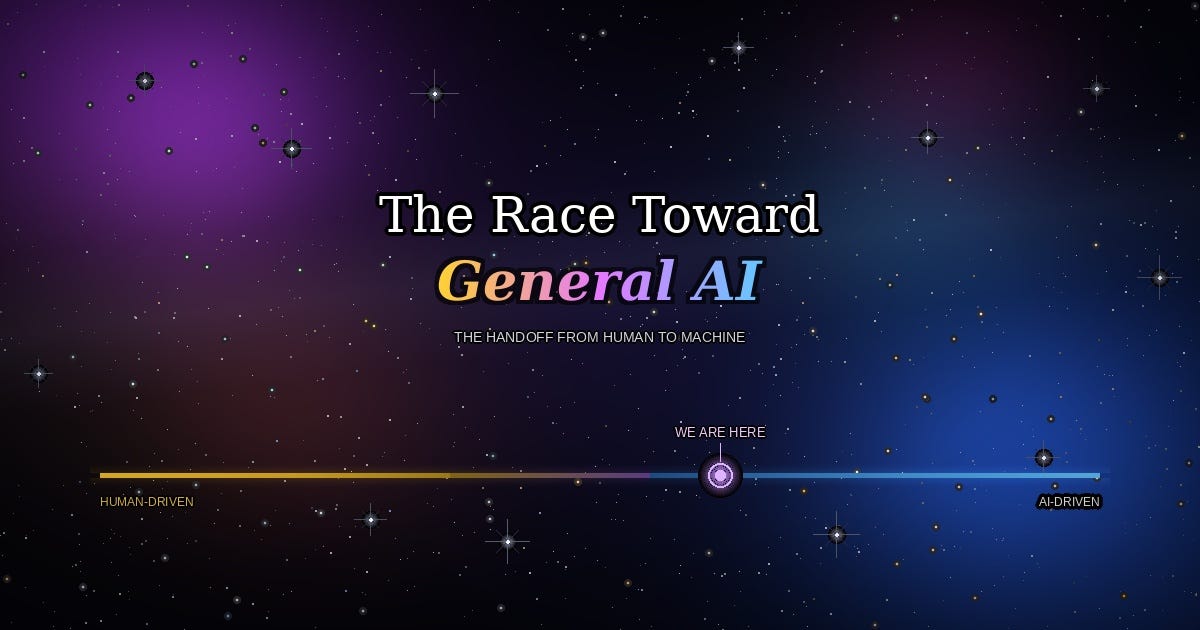
We’re living through the most consequential period in the history of artificial intelligence. Headlines about AI appear daily, companies are investing hundreds of billions, and the people building these systems are making predictions that sound like science fiction. But beneath the hype, something real is happening—and it’s moving faster than most people realize. The central question is no longer whether we’ll achieve Artificial General Intelligence, but when—and at what point the machines start building themselves.
First, What Exactly Is AGI?
Today’s AI systems are impressive but narrow. ChatGPT can write an essay, but can’t drive your car. An AI can beat the world’s best chess player, but can’t order you lunch. Each tool is built for a specific set of tasks. This is called narrow AI, and it’s what we interact with every day.
Artificial General Intelligence is something fundamentally different. AGI refers to an AI system that can learn and perform any intellectual task a human can—across every domain—with the flexibility to handle situations it was never specifically trained for. Think of it this way: narrow AI is a specialist. AGI is a polymath. It could write a legal brief in the morning, debug software after lunch, design a scientific experiment in the afternoon, and negotiate a business deal by dinner—all without being reprogrammed for each task.
The key ingredients most researchers agree on include broad competence across unrelated fields, the ability to transfer knowledge from one domain to another, the capacity to learn new skills with minimal guidance, and robust performance in messy, real-world situations where the rules aren’t clearly defined. In short, AGI would think the way a highly capable human does—just faster, and without getting tired.
How Is AGI Different from Today’s AI?
The difference between AI and AGI isn’t just a matter of degree—it’s a difference in kind. Current AI systems, no matter how impressive, are fundamentally tools. They excel within the boundaries they were designed for, but they break in predictable ways outside those boundaries. Ask an image-recognition AI to write poetry, and you’ll get nothing. Ask today’s language models to operate autonomously on a complex, multi-week project with no human oversight, and they’ll stumble.
AGI closes that gap. It wouldn’t just answer questions—it would know which questions to ask. It wouldn’t just follow instructions—it would set its own goals, identify what it doesn’t know, go learn it, and execute a plan. The jump from AI to AGI is roughly analogous to the jump from a calculator to a human mathematician. The calculator is faster at arithmetic, but the mathematician understands what the numbers mean.
When Will AGI Arrive?
This is where things get heated. Predictions from the people closest to the work have been converging rapidly. Leaders at the major AI labs—Anthropic, OpenAI, Google DeepMind, and xAI—have recently placed their estimates in the 2027 to 2030 range. Dario Amodei, CEO of Anthropic, has expressed high confidence that AGI will arrive around 2026–2027. Ray Kurzweil’s long-standing prediction of 2029 continues to look increasingly plausible.
The optimistic case is grounded in real evidence: AI capabilities are compounding at an extraordinary rate, investment is at record levels, and recent models are already performing at an expert level across many cognitive benchmarks. Aggregated surveys of AI researchers show timelines shortening dramatically, with median predictions moving up by years in just the past few cycles.
But there are legitimate reasons for caution. Some researchers argue we’re approaching diminishing returns on current architectures. The gap between “impressive on a demo” and “reliably operates autonomously in the real world” is consistently underestimated. Challenges around energy consumption, data limitations, and robust reasoning in genuinely novel situations remain unsolved. Skeptics push timelines out to the 2030s or even 2040s. A realistic, honest assessment puts the most likely window somewhere between the late 2020s and mid-2030s—with genuine uncertainty in both directions.
How Will AGI Get Discovered—and the Coming Handoff
Today, the push toward AGI is overwhelmingly human-driven. Small teams of brilliant researchers at a handful of labs are making the critical conceptual leaps—designing new architectures, developing training methods, and deciding which problems to tackle next. The coders and engineers are building the infrastructure. The visionary leaders are setting direction and attracting the capital to fund the work.
But here’s what I believe is the most important dynamic to understand about AGI: somewhere very close to the point of AGI’s emergence, the process of building AI will shift from being mostly human to being mostly the AI itself.
This is already beginning. AI systems are writing significant portions of their own code, identifying promising research directions, and helping optimize their own training. The feedback loop between human researchers and AI tools is tightening with every generation. Each new model is more capable of contributing to the development of its successor. What starts as AI assisting human engineers gradually becomes AI doing the heavy lifting while humans steer.
At some point in this progression—and I believe it will happen close to the moment we’d recognize as AGI—the balance tips. The AI’s contribution to its own improvement becomes the primary driver of progress, not the human’s. The researchers will still matter, but increasingly in the way an architect matters after the foundation is poured: setting direction, not laying every brick. This isn’t a sudden, dramatic event. It’s a gradual handoff that’s already underway, and by the time most people notice it’s happened, it will be well past the tipping point.
This is both the promise and the challenge of AGI. The same self-improvement capability that could accelerate scientific breakthroughs, cure diseases, and solve problems we can’t yet imagine also demands that we get alignment right—ensuring these systems remain pointed in a direction that serves humanity. The window for getting that right may be shorter than we think.
We are not spectators to this story. The decisions being made right now—by researchers, policymakers, and the AI systems themselves—will shape the trajectory of this technology for decades to come. Understanding what AGI is, when it might arrive, and how the handoff from human to machine is already underway isn’t just interesting. It’s essential.